- Home Page /
- Books /
- Computers & Technology /
- Programming /
- Software Design, Testing & Engineering /
- Testing /
- DevOps Tools for Java Developers: Best Practi...


Item #:
154021995
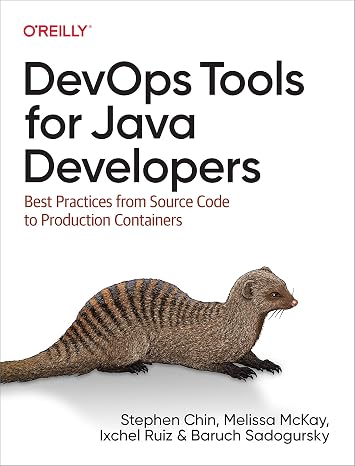
DevOps Tools for Java Developers: Best Practices from Source Code to Production Containers
88% of respondents would recommend this to a friend
Item #:
154021995
KMF 31361
Price Details
Excluding Shipping & Custom charges ( Shipping and custom charges will be calculated on checkout )
*All items will import from US
0 ratings
Write a review
In stock
 Imported from USA store
QTY:
Order now and get it around Friday, October 09
Secured transaction
Ubuy works hard to protect your security and privacy. Our advanced payment security system ensures confidentiality by encrypting your information during transmission using AES (Advanced Encryption Standards) and SSL (Secure Socket Layer) protocols. Your payment details are 100% secure as we do not share your payment details with third party sellers.
Our Top Logistics Partners


This practical guide helps you take advantage of microservices, serverless, and cloud native technologies using the latest DevOps techniques to simplify your build process and create hyperproductive teams.

Fast
Shipping

Free
Return*

Secure Packaging

100% Original Products

PCI DSS Compliance

ISO 27001 Certified



Note: Step Down Voltage Transformer required for using electronics products of US store (110-120). Recommended power converters Buy Now.


What Stands Out
Comprehensive Guide
Covers best practices for Java developers, detailing the complete DevOps lifecycle from source code management to production deployment, ensuring a smooth and efficient pipeline.
Focused on Containers
Emphasizes containerization, teaching Java developers how to leverage Docker and Kubernetes for scalability and portability, enhancing deployment efficiency and reducing runtime issues.
Expert Insights
Written by industry professionals, providing real-world experience and tips that simplify complex DevOps processes, empowering developers to apply these strategies immediately.
Product Details
| Publisher | O'Reilly Media |
| Publication date | May 24, 2022 |
| Edition | 1st |
| Language | English |
| Print length | 341 pages |
| ISBN-10 | 1492084026 |
| ISBN-13 | 978-1492084020 |
| Item Weight | 1.23 pounds (560 grams) |
| Dimensions | 7 x 0.5 x 9 inches (17.8 x 1.3 x 22.9 cm) |
Who Should Buy?

-
Java Developers
Java developers looking to enhance their DevOps practices will find valuable insights in this comprehensive guide.
-
DevOps Enthusiasts
Individuals interested in improving their skills in DevOps can apply the best practices highlighted in this book.
-
Team Leaders
Team leaders aiming to implement effective DevOps strategies in Java development teams will benefit from the practical approaches shared.

-
Beginners
Those new to programming or DevOps might find the concepts challenging without prior foundational knowledge.
Product Description
DevOps Tools for Java Developers: Best Practices from Source Code to Production Containers
Have any Query? Chat with us
Customer Questions & Answers
-
Question:
What are the best practices for using DevOps tools in Java development?
Answer: Implementing best practices like Continuous Integration (CI) and Continuous Deployment (CD) is crucial for Java developers using DevOps tools. CI ensures that code changes are regularly tested and integrated, reducing integration issues down the line. CD automates the release process, allowing for rapid rollouts and quick feedback. Utilizing containerization tools such as Docker helps to streamline environments, ensuring consistency from development to production. For example, a Java team can integrate Jenkins for CI and use Docker for containerization to enhance deployment speed and reliability. -
Question:
How do DevOps tools enhance collaboration in Java development?
Answer: DevOps tools foster collaboration through streamlined communication and shared tooling in the software development lifecycle. Tools like Slack, Jira, and Git enhance transparency and facilitate feedback loops between developers and operations teams. This synergy enables teams to respond to issues more effectively and prioritize tasks collaboratively. For instance, using Git for version control allows developers to work on different features simultaneously while maintaining a clear overview of progress, minimizing conflicts, and improving productivity. -
Question:
What role do containers play in Java development?
Answer: Containers are pivotal in Java development as they ensure that applications run consistently across various environments. Tools like Docker encapsulate Java applications with their dependencies, enhancing portability and scalability. This allows developers to effectively replicate production environments on local machines, reducing the 'it works on my machine' syndrome. For instance, a Java web application can be packaged as a Docker image and deployed seamlessly across various cloud platforms, simplifying scaling and managing microservices architecture. -
Question:
Which DevOps tools are essential for Java developers?
Answer: Key DevOps tools important for Java developers include Jenkins for CI/CD, Docker for containerization, Kubernetes for orchestration, and Git for version control. Jenkins automates the testing and deployment process, while Docker streamlines application deployment. Kubernetes manages containerized applications, ensuring scalability and high availability. Additionally, Git allows teams to collaborate efficiently on code. A typical setup might involve using Jenkins alongside Docker to automate testing and deployment, facilitating rapid releases with fewer errors. -
Question:
What is the significance of CI/CD in Java development?
Answer: CI/CD is significant in Java development as it automates much of the software development process, leading to faster and more reliable software releases. Continuous Integration (CI) allows teams to integrate code changes frequently, while Continuous Deployment (CD) automates the release of code to production. This practice reduces manual effort and minimizes the risk of deployment errors. A Java application that employs CI/CD can release new features much more frequently, responding to user feedback quickly and enhancing overall product quality. -
Question:
How do I set up a CI/CD pipeline for a Java application?
Answer: Setting up a CI/CD pipeline for a Java application involves several steps: First, version control your code using Git. Next, integrate Jenkins to automate builds and tests. You would then configure a testing framework like JUnit to run unit tests on your code. After successful tests, use Docker to containerize your Java application. Finally, implement a deployment strategy to automate the release process, ensuring that new code is deployed to production seamlessly. This setup allows for consistent deliveries and faster feedback cycles in your development process. -
Question:
What are the security considerations in DevOps for Java applications?
Answer: Security in DevOps for Java applications requires integration of security measures throughout the development lifecycle, often referred to as DevSecOps. Implement practices such as regular code reviews, using security testing tools to identify vulnerabilities, and ensuring dependencies are up to date. Additionally, implementing access controls and monitoring in production reduces the risk of unauthorized access. For instance, integrating tools like SonarQube can help analyze your Java code for security flaws early in the development process, enhancing your application's resilience. -
Question:
How can I monitor my Java applications in production?
Answer: Monitoring Java applications in production can be achieved through various tools that track performance metrics, logs, and errors. Tools like Prometheus for metrics gathering and Grafana for visualization help track application health and performance. Additionally, centralized logging solutions like ELK stack (Elasticsearch, Logstash, and Kibana) can be used to analyze logs in real-time. For example, if an application experiences latency, these monitoring tools can help identify bottlenecks quickly, allowing for timely fixes and maintaining user satisfaction. -
Question:
What languages do DevOps tools support aside from Java?
Answer: While many DevOps tools focus heavily on Java, they also support a range of other programming languages such as Python, Ruby, JavaScript, and Go. Tools like Jenkins, Docker, and Kubernetes are designed to be language-agnostic and can manage applications written in various programming languages. For instance, a DevOps team can deploy a microservices architecture where some services are built in Java while others are implemented in Python without facing integration issues, thus promoting flexibility in technology choices. -
Question:
Where can I buy DevOps Tools For Java Developers Best Practices From Source Code To Production Containers?
Answer: You can purchase 'DevOps Tools For Java Developers Best Practices From Source Code To Production Containers' on Ubuy in Comoros. Ubuy offers a wide range of educational resources and tools that are beneficial for Java developers looking to enhance their expertise in DevOps practices. Shopping on Ubuy guarantees a seamless experience with a variety of options that can meet your specific learning needs.
Testing Editorial Review
DevOps Tools for Java Developers: Best Practices from Source Code to Production Containers offers a comprehensive exploration of essential DevOps practices tailored for Java developers. The authors, all recognized Java Champions, draw from their extensive experience to deliver insightful content covering topics such as DevOps fundamentals, container best practices, and continuous deployment strategies. Readers appreciate the book for its clarity and depth, praising its ability to guide both novice and seasoned developers in understanding complex concepts while presenting practical tools for successful software delivery. The book’s standout feature is the in-depth chapter on deployment, which thoroughly examines key practices and technologies relevant to containers and Kubernetes.
Customer Reviews & Ratings
1 customers ratings
-
5 Star
100%
-
4 Star
0%
-
3 Star
0%
-
2 Star
0%
-
1 Star
0%
Review this product
Share your thoughts with other customers
Pros
- Comprehensive coverage of DevOps principles for Java developers
- In-depth focus on container best practices
- Valuable insights from recognized Java Champions
- Approachable for both beginners and experienced developers
- Focus on practical tools and methodologies
Cons
- Some readers may prefer a deeper exploration of specific topics.
Platform Trust & Buyer Confidence

JK
Jasmin
Verified buyer
“Great products and very good service: very easy and very fast international delivery.”
9 September 2026 · via Trustpilot
AG
Anke
Verified buyer
“Wonderful online shopping experience, smooth transaction from the start. Payment method works conveniently and delivery is unexpectedly fast and reliable. You go the extra mile for service. What makes this even more amazing, you deliver to Namibia. I will remain a happy Ubuy customer and will increase my purchases for sure! Thank you!”
10 September 2026 · via Trustpilot
H
Hazel
Verified buyer
“Very easy to find the products what you need, and so fast delivery, that’s why I highly recommended to others costumers to used ubuy.”
10 September 2026 · via Trustpilot
O
Opaleye
Verified buyer
“I received exactly what I ordered I was skeptical about your site because that was my first time to order. But the order came timely and neatly packaged. I was not disappointed. Thank you.”
11 September 2026 · via Trustpilot
AC
Adele
Verified buyer
“Easy to find and order what you want on the website. Delivery is quick to the UK”
8 September 2026 · via Trustpilot
Secure Checkout
Global Delivery
Easy Returns
Genuine Products
Product Price History
Important information
- Limitations : For products shipped internationally, please note that any manufacturer warranty may not be valid; manufacturer service options may not be available; product manuals, instructions, and safety warnings may not be in destination country languages; the products (and accompanying materials) may not be designed in accordance with destination country standards, specifications, and labeling requirements; and the products may not conform to destination country voltage and other electrical standards (requiring use of an adapter or converter if appropriate). The recipient is responsible for assuring that the product can be lawfully imported to the destination country. When ordering from Ubuy or its affiliates, the recipient is the importer of record and must comply with all laws and regulations of the destination country.
- Not all the products listed on Ubuy are for sale, as Ubuy is a global search engine. Products are subject to export/trade regulations.
KMF 31361
Order now and get it around Friday, October 09
This item is not restrict in my country.(Please click on above link if this item is not restrict in your country, So our team will review and allow.)
QTY:
Secured transaction
PCI DSS compliant and ISO 27001:2022 certified, with encrypted payments and full buyer protection on every order.
Our Top Logistics Partners
Fastest cross-border delivery
Features & Benefits
- Leverage microservices, serverless, and cloud native technologies.
- Simplify your build process with the latest DevOps techniques.
- Achieve hyperproductivity in your development teams.
- Includes comprehensive practices for Git, Maven, CircleCI, and Docker.
- Covers popular frameworks like Jakarta EE, Spring Boot, and more.
- Empowers you to manage and secure software dependencies effectively.
Ubuy Assurance
Experience worry-free shopping with 100% original products, PCI DSS-compliant payment security, ISO 27001-certified data protection, the fastest cross-border delivery, free returns *, and secure packaging on every order.